Can Dogs Eat Popcorn? A Neurologist-Trained Vet Flips the Bag First
Medically reviewed by Roger Clemmons, DVM, PhD, DACVIM (Neurology and Neurosurgery), CVA, CVFT — For general education — not a substitute for veterinary care.
Yes — plain, air-popped popcorn is fine in small amounts, but butter, salt, and stray kernels turn it risky fast.

On this page
Picture a Friday movie night: the bowl comes out, the dog’s chin is already on your knee, and the question isn’t whether to share — it’s whether you should. That small hesitation is worth trusting. As Can Dogs Eat Popcorn? explains, popcorn sits in an odd spot in the canine diet conversation: the corn itself is unremarkable, but almost everything humans do to it before eating is not.
So here’s the direct answer, the kind I’d give before we go any further: plain, fully popped, air-popped popcorn is a reasonable low-stakes snack for most healthy adult dogs in small amounts. Everything past that sentence is about what changes the math.
What’s Actually in the Bowl
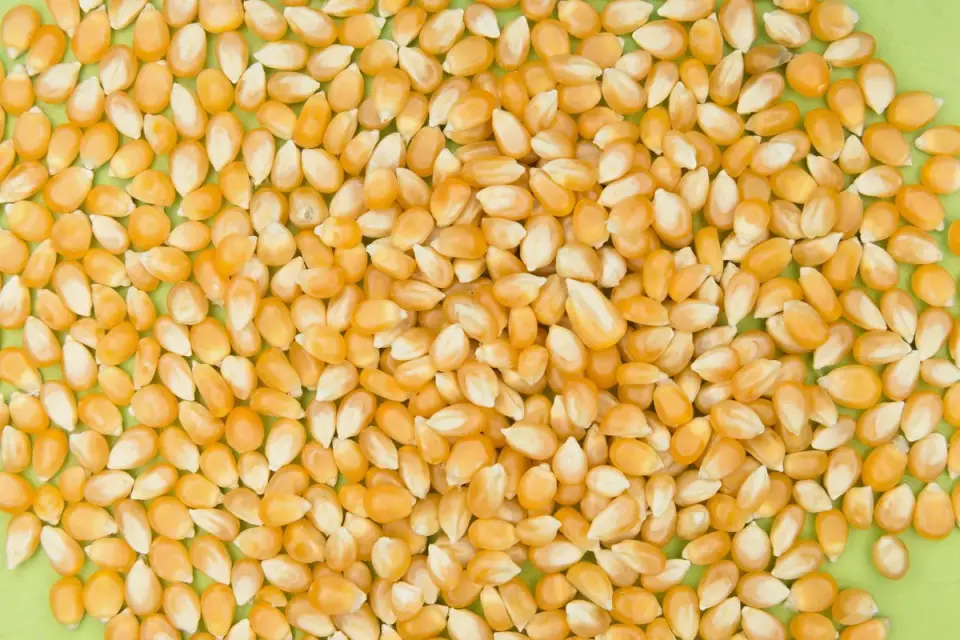
A popped kernel is mostly starch and a bit of fiber from the hull. On its own, that’s not dangerous — it’s just not doing much nutritionally either. The trouble starts with the kernels that don’t fully pop. Those half-popped or unpopped pieces are hard, dense, and roughly the wrong shape for a dog’s throat. They can wedge between molars, work into gum tissue, or, in a worse case, get swallowed whole and sit somewhere they shouldn’t. Always sort the unpopped kernels out before offering any. That’s not a nutrition rule; it’s a shape-and-size rule, and it matters more for small dogs and enthusiastic gulpers than for a dog who chews everything slowly.
The Toppings Do the Damage
Movie-theater popcorn is really a butter-and-salt delivery vehicle that happens to be corn-shaped. That’s the real hazard, and it’s worth naming specifically rather than waving at generally. Salt, in enough quantity, can push a dog toward excess thirst, vomiting, and in severe cases something closer to sodium overload — the kind of picture covered in Can Dogs Eat Salt?: PetMD’s overview on salt. Butter is the other half of the problem, and it’s a fat problem more than a dairy one: a fatty topping on top of a dog’s normal diet is a documented trigger for a pancreatitis flare, particularly in dogs who’ve had one before or who run a bit heavier already. Caramel corn and kettle corn add sugar into that mix, and some sugar-free versions substitute xylitol, which is a genuinely dangerous ingredient at any dose. None of that is about the popcorn. It’s about what rode in with it.
When a Kernel Becomes a Bigger Problem
Consider a mid-size terrier mix who snags a fallen handful off the rug before anyone notices — kernels, hulls, and all. For the first hour, nothing looks wrong. By the next morning, though, there’s some gagging after breakfast and a stretch of straining that doesn’t produce much. That’s the pattern worth watching for, not because it happens every time, but because it’s exactly the kind of quiet blockage risk that unpopped kernels create. A dog in that position doesn’t need a lecture about popcorn; it needs an owner who notices the gagging, tracks the next 24 hours, and calls the vet if the straining or lethargy doesn’t resolve on its own. I’d rather a reader over-monitor a dog after an accidental kernel binge than assume it’ll pass on its own, because the cost of being wrong there is a lot higher than the cost of a phone call.
This is also where I think about dogs whose digestion is already working at a deficit. Exocrine pancreatic insufficiency is a good example: dogs with that condition are managed with enzyme replacement and a JAVMA review notes they typically need low-residue diets with moderate fat, which makes a fatty, fibrous handful of popcorn a genuinely worse idea for them than for a dog with an unremarkable gut. The same review is candid that researchers still don’t fully understand why dysbiosis persists in some of these dogs even after enzyme therapy starts — which is a fair reminder that the gut’s response to any new food, popcorn included, isn’t perfectly predictable from first principles.
How the Gut Handles a Handful
Here’s where I stay anchored to mechanism rather than promise. Popcorn’s fiber is fermented by gut bacteria, and how well a given dog handles that fermentation has more to do with that individual’s microbiome than with the popcorn itself. A Frontiers in Veterinary Science study on probiotic response in dogs found that diversity metrics alone didn’t distinguish which dogs responded to supplementation and which didn’t — a useful humility check before anyone claims a fiber snack or a probiotic will predictably smooth out a dog’s stool. If you’re already managing a dog’s fiber intake carefully, it’s worth reading Yes, You Can Give a Dog Too Much Fiber before adding popcorn on top of a fiber-forward diet, and our Best Probiotic for Dogs roundup is a reasonable next stop if loose stools are already a pattern rather than a one-off.
The Verdict, Flipped Bag and All
A few pieces of plain, air-popped popcorn — no butter, no salt, no unpopped kernels mixed in — is a fine occasional snack for most healthy dogs. It’s not a food I’d build a routine around, and it’s not a fiber source I’d rely on when there’s a purpose-built option available, the same way sweet potato makes more nutritional sense as an actual add-in than popcorn ever will. Skip it entirely for dogs with a pancreatitis history, active GI symptoms, or a habit of swallowing food whole. Sort the kernels out first, every time. That last part isn’t optional.
Frequently asked questions
Can dogs eat popcorn chicken or caramel popcorn?
No. Popcorn chicken usually carries breading, oil, and seasoning salt, and caramel or kettle corn is loaded with sugar and sometimes butter-flavored fat. Neither resembles the plain, air-popped version that's reasonable in small amounts.
My dog swallowed a handful of unpopped kernels — what now?
Watch for gagging, repeated swallowing, drooling, or reluctance to eat, which can point to a kernel stuck near the throat or teeth. Vomiting, straining, or a firm, painful belly over the following day or two can signal a partial blockage further down, and that warrants a same-day call to your vet.
Is popcorn ever a good source of fiber for dogs?
Popped corn does carry some insoluble fiber, but it's an inefficient and inconsistent way to get it — a dog's gut has to work around the hull fragments rather than benefit cleanly from them. A vet-formulated fiber source is a more predictable choice if fiber is actually the goal.
Sources
- Can Dogs Eat Popcorn? — PetMD
- Can Dogs Eat Salt? — PetMD
- Exocrine pancreatic insufficiency review — JAVMA
- Probiotic response variability in dogs — Frontiers in Veterinary Science