Canned Pumpkin vs. Pumpkin Powder for Dog Diarrhea: What Actually Bulks the Stool
Medically reviewed by Kendra Pope, DVM, DACVIM (Oncology), CVA, CVCH, CVFT, CVTP — For general education — not a substitute for veterinary care.
Canned pumpkin and pumpkin powder both add soluble fiber, but they don't behave the same way in a gut that's already losing water.

On this page
Gus was a nine-year-old beagle mix, thirty-one pounds, who’d had loose stool for two days after a weekend at his owner’s parents’ house — table scraps, a new water source, the usual culprits. It was a Saturday, my clinic was closed, and his owner did what half my clients do before they ever call me: she went to the pantry. She had a can of plain pumpkin left over from a fall baking project and no pumpkin powder in the house. She gave him a spoonful with breakfast and another with dinner. By Monday, when she called to ask if she should keep going or bring him in, his stool was already firming up.
I tell that story not because it proves pumpkin works — one dog’s weekend isn’t evidence of anything — but because it’s the exact scenario that gets people asking the canned-versus-powder question. They already believe in pumpkin. What they don’t know is whether the pantry can or the pouch of powder on the supplement shelf is actually the better tool, or whether it matters at all once you account for how much water is already leaving the colon.
What Soluble Fiber Is Actually Doing in the Colon
Diarrhea, in the simplest mechanical sense, is a mismatch between how much water enters the large intestine and how much gets reabsorbed before the stool exits. Soluble fiber — the kind pumpkin is rich in, mostly as pectin — absorbs water and swells into a gel, which adds bulk and slows transit. As gut bacteria ferment it, they produce short-chain fatty acids that feed colonocytes, help lower colonic pH, and support water and sodium reabsorption. That’s the mechanism AKC describes when it explains why pumpkin has become the go-to home remedy for mild loose stool: the fiber isn’t sedating the gut, it’s giving it something to hold onto.
That mechanism doesn’t care whether the fiber arrives wet or dry. What it cares about is total soluble fiber delivered relative to the dog’s size, and how much additional water comes along for the ride.
Canned Pumpkin: The Original, and Why It Still Works
Canned, unsweetened pumpkin puree is mostly water — somewhere in the 90% range — with the fiber and nutrients concentrated by the canning process relative to fresh pumpkin. That’s part of its appeal for a mildly dehydrated dog with diarrhea: you’re delivering fiber and a little extra fluid in the same spoonful. AKC’s guidance lands on roughly one to four tablespoons of pumpkin or pumpkin powder mixed into a meal, scaled to the dog and started small, which tells you the two forms are treated as interchangeable in dose language even though they aren’t interchangeable in composition.
The tradeoff is volume and shelf life. A thirty-one-pound dog like Gus needs a real spoonful, not a token amount, and an open can doesn’t keep past a few days in the fridge before it’s compost. For an occasional bout of loose stool, that’s a non-issue. For a dog who needs fiber support most weeks, it becomes a recurring grocery-store errand and a lot of half-used cans.
Pumpkin Powder: Same Fiber, Different Water Math
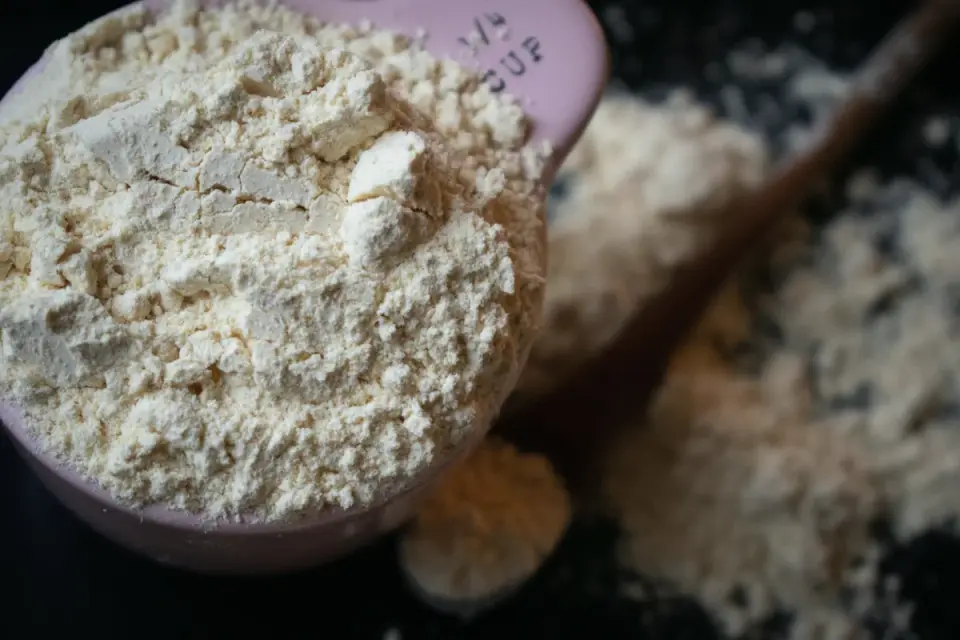
Dehydration removes the water and concentrates everything else — fiber, sugars, nutrients — into a fraction of the volume. That’s why powder doses run in fractions of a teaspoon to a teaspoon rather than tablespoons: a small dog might get a quarter teaspoon, a large dog closer to a full teaspoon, delivering a comparable fiber load in a much smaller scoop. It doesn’t spoil the way an opened can does, and a bag lasts months in the pantry.
What it doesn’t bring is the water. If a dog is already losing fluid through loose stool, canned pumpkin’s built-in moisture is doing a small amount of quiet work that powder can’t replicate on its own — you’d need to mix the powder with water or wet food to get anywhere close. Powder is also easy to over-dose relative to its concentration; a “generous spoonful” habit that was harmless with canned pumpkin can deliver meaningfully more fiber per gram once it’s dehydrated, which is worth knowing before you eyeball it.
Where the Comparison Actually Breaks Down
In my practice, the canned-versus-powder question usually isn’t really about fiber chemistry — it’s about what’s already in the house when a dog’s stool goes soft on a Friday night. That’s a fine reason to pick one over the other. But neither form is doing anything for diarrhea that isn’t already better documented with psyllium husk, which is the soluble fiber source with actual published outcome data behind it. A study on police working dogs with chronic idiopathic large-bowel diarrhea, published in the PMC repository, found that a month of psyllium husk supplementation produced a “very good” response in half the dogs and a “good” response in another 40%, with defecation frequency and stool consistency both improving. Pumpkin has never been put through that kind of trial. It’s cheap, it’s palatable, and the mechanism is real — but the confidence behind it is closer to “widely used and plausible” than “clinically proven.”
The Counterargument I Take Seriously
The strongest pushback I hear is fair: pumpkin is what people already have, dogs generally like it, and for a mild, self-limiting bout of loose stool, waiting on better evidence before reaching for the pantry can is overkill. I don’t disagree with that for a healthy adult dog with one or two days of soft stool and no other symptoms. Where I push back is on treating pumpkin — canned or powdered — as a substitute for diagnosis when diarrhea persists, when there’s blood, lethargy, vomiting, or weight loss, or when it recurs often enough that “just add pumpkin” has become a monthly ritual instead of an occasional fix. At that point the fiber is masking a pattern worth actually working up, not managing it.
A Second Dog, Different Season
I saw an eleven-year-old Lab named Marlowe about four months after his owner started keeping pumpkin powder in the pantry specifically because canned pumpkin kept going to waste. He’d had two short diarrhea episodes that year, both resolved within two or three days of powder mixed into his dinner, and the owner had gotten comfortable enough with dosing that she’d stopped calling me every time. What changed my read of the case wasn’t the pumpkin — it was that a third episode showed up in early winter with no dietary trigger I could find, lasted five days instead of two, and came with a drop in his energy on stairs he used to take without pausing. The pumpkin had done its job twice. The third time, it was covering for something that needed bloodwork, not a bigger scoop. That’s the pattern I watch for with any home fiber remedy: it works reliably until, one time, it doesn’t, and that failure is the actual signal.
Reading the Label Either Way
Whichever form you buy, check that it’s plain pumpkin — puree or dehydrated — with no added sugar, spices, or xylitol-containing sweeteners, since pumpkin pie filling is a real and common mistake. If you’re comparing supplement-aisle fiber products more broadly, the same label discipline applies to other formats: our guide to chew vs. powder vs. liquid supplements covers how format changes what a dog actually absorbs, and our look at freeze-dried versus powder supplements walks through how dehydration methods affect potency claims — both relevant if you’re deciding between a can and a canister for reasons beyond convenience. If loose stool is recurring enough that you’re reaching for probiotics too, it’s worth understanding how prescription veterinary probiotics differ from over-the-counter options before you stack remedies without a diagnosis underneath them.
Where I Land
For a single mild episode, I don’t think it matters much which form you reach for — canned pumpkin if you have it and don’t mind the moisture, powder if you want a shelf-stable option you can dose in fractions of a teaspoon. What matters more is treating either one as a short-term bridge, not a maintenance plan, and noticing when the pattern changes. Owners who track how many days an episode lasts, and whether it’s getting more frequent rather than less, are the ones who catch the cases that actually need a workup. Fiber can buy you information as much as it buys firmer stool — pay attention to what it’s telling you.
Frequently asked questions
Can I switch between canned pumpkin and pumpkin powder without changing the dose?
Not exactly — powder is concentrated, so a spoonful isn't equivalent to a spoonful of canned puree. Start with the lower end of any dosing guidance and adjust based on stool response rather than assuming a 1:1 swap.
Sources
- Can Pumpkin Help With Dog Diarrhea? — AKC
- The use of soluble fibre for the management of chronic idiopathic large-bowel diarrhoea in police working dogs — PMC (National Center for Biotechnology Information)