Dog Car Seat Belt vs Crate vs Barrier: Which Restraint Is Safest?
Seat belt harness, crate, or barrier — the honest answer starts with which one has actually been crash tested at highway speed.

On this page
A twelve-pound terrier mix named Biscuit came into my exam room for a limp that started, the owner told me, “out of nowhere.” It wasn’t out of nowhere. Two days earlier she’d braked hard for a deer, and Biscuit — riding loose on the back seat, no harness, no crate — had slid into the door frame. No fracture, thankfully, just a bruised shoulder and a very startled dog. I’ve had versions of that conversation more times than I can count, and it’s rarely the highway wreck that does the damage. It’s the ordinary hard stop, the pothole swerve, the moment a dog isn’t braced for what the car is about to do.
That’s the frame I want you to hold onto as we go through seat belt harnesses, crates, and barriers, because the marketing on all three tends to promise more than the hardware behind it delivers.
What “crash tested” actually means, and why most products aren’t
Most restraint products sold as dog car safety gear have never been crash tested at all — they’re rated for holding a dog in place during normal driving, not for surviving a 30 mph frontal impact. The organization that changed that is the Center for Pet Safety, a nonprofit that partnered with Subaru and an NHTSA-contracted lab, MGA Research Corporation, to run actual crash sled tests using instrumented dog-shaped test dummies. Their protocol is adapted from Federal Motor Vehicle Safety Standard 213 — the same standard used to certify child car seats. That distinction matters more than almost anything else on a product label: a harness described as “heavy-duty” or “crash-tested” by the manufacturer, with no independent lab behind that claim, tells you very little.
The American Veterinary Medical Association’s guidance on pet safety in vehicles is direct about this gap: it’s unsafe for a dog to ride loose in a moving car, and the group specifically points owners toward products independently crash tested by the Center for Pet Safety rather than relying on packaging claims. That’s the baseline I use with clients — not “does it look sturdy,” but “has anyone actually crashed it on purpose and measured what happened.”
Seat belt harnesses: wide variation, and the failure mode is ugly
A seat belt harness clips a dog’s existing (or dedicated) harness to the car’s seat belt system, usually through the strap or a tether attached to the buckle. Done right, this keeps a dog anchored in one seat and out of the front footwell during a stop. Done wrong, it fails in a way that’s specific to harnesses: under crash force, a poorly constructed chest strap or D-ring can pull through, tear, or let the dog’s body rotate forward past the strap entirely — meaning the dog is still technically “restrained” by a broken product but has traveled several feet forward regardless.
In the Center for Pet Safety’s testing program, this is the category where they documented catastrophic failures — straps separating from the webbing, buckles releasing under load, dogs launching off the seat despite being clipped in. Not every harness on the market behaves this way, but the study is the reason I tell clients that “harness” is not a single category with one safety level; it’s a spectrum, and the label alone won’t tell you where a given product sits on it.
Crates: the most consistent performer, with real caveats
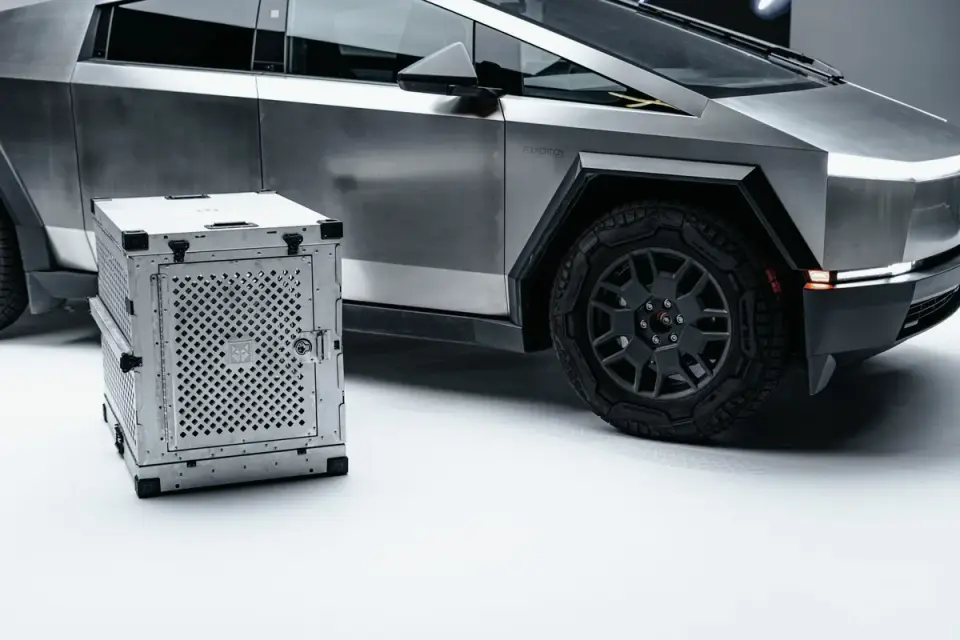
A hard-sided crate, secured to the vehicle with its own tie-down straps rather than just wedged behind a seat, was the standout in CPS’s crate studies — the Gunner Kennels G1 Intermediate with 8-foot tie-down straps held up under testing conditions that broke other products. The logic tracks with what I see clinically: a crate contains the dog’s whole body inside a rigid structure, so instead of one strap trying to arrest forward momentum at a single point, the impact force is distributed across the crate’s frame and its anchor straps.
The caveat is that this only holds for crates that are actually secured to the car — a crate sitting loose in a cargo area or hatchback can become a projectile itself in a collision, striking the dog inside it or anyone in the front seats. The crate has to be the right size for the dog (enough room to stand and turn, not so much that the dog is thrown around inside it) and it has to be tied down with straps rated for that purpose, not bungee cords or whatever’s in the garage.
Barriers: good for distraction, not built for crash force
A cargo barrier — mesh, metal grate, or a hard divider between the back seat or cargo area and the front — keeps a dog from climbing into the driver’s lap or the front footwell, which does address a real and common problem: unrestrained pets are a recognized source of driver distraction, and a dog in the front seat is directly in the path of an airbag designed for an adult human, not a 30-pound dog. That’s a legitimate safety function.
What a barrier does not do is prevent a dog from being thrown around within whatever space it’s still allowed to occupy. A barrier stops forward-into-the-front-seat motion; it does nothing about lateral motion, rollover, or the dog’s own body slamming into the wheel wells, the barrier itself, or another passenger back there. I’ve seen dogs come in with soft tissue injuries from exactly that — the barrier did its one job and the dog still got hurt inside the space it was confined to. A barrier is a good add-on. On its own, it’s not a restraint system.
What I actually recommend, and why
For most dogs, a crash-tested crate, properly sized and tied down with rated straps, is the restraint I steer clients toward first. It’s not the most convenient option — it takes up more space than a harness and it’s not something you can improvise from gear you already own — but it’s the category where independent testing shows the most consistent containment under real crash force, and it protects the dog from itself in ways a harness alone doesn’t always manage.
The honest counterargument is convenience and cost. A crash-tested crate plus rated tie-down straps runs more than a basic harness, takes up real cargo space, and isn’t practical for every vehicle or every trip. For a dog who travels constantly in a hatchback with no cargo room to spare, a genuinely crash-tested harness — one you’ve confirmed against CPS’s published results, not the label — paired with a barrier to block the front seat is a reasonable second-best. What I don’t recommend is a harness or barrier bought on marketing language alone, with no crash data behind it, because that’s the product category where I’ve seen the ugliest failures.
I had a client a few years back — a lab mix, maybe sixty pounds, four years old — whose owners drove two hours each way to visit family most weekends. They’d been using a basic harness clip for a year with no issues, which is exactly the trap: nothing happens until something does. We talked through switching to a crash-tested crate for the back of their SUV, sized to let the dog turn around but not slide, tied down at four points. It cost them a Saturday afternoon to install correctly and about the price of a nice dinner out. Eighteen months later, they hit a deer at 45 miles per hour on a rural road at dusk. The crate held. The dog had a scare and a scraped nose from the impact inside the crate, nothing more. That’s the timeline I want owners picturing when they’re deciding whether the switch is worth it — not the average drive, but the one bad afternoon that decides whether “restrained” actually meant something.
If your dog gets carsick rather than just restless, it’s worth reading about why a dog vomits every time it goes for a car ride and how ginger versus chamomile actually compares before you assume a new restraint is the fix — sometimes it’s the motion, not the setup. And if you’re building out a full travel kit rather than just a daily commute, how to fly with a dog covers the carrier standards that apply once you’re off the road entirely.
Brief recap
Crash-tested matters more than the word “safety” on a label — check whether a product has actually been through the Center for Pet Safety’s protocol before trusting it. Crates that are properly sized and tied down are the most consistent performer in independent testing. Harnesses vary enormously and the failure mode, when it happens, tends to be dramatic. Barriers solve the front-seat problem but not the crash-force problem, and work best as an addition, not a stand-alone system.
Frequently asked questions
Is a crash-tested harness as safe as a crash-tested crate for dogs in cars?
It depends on the specific product and how it's installed. Crates tested and anchored properly have shown the most consistent containment in independent crash testing, but a genuinely crash-tested harness — one verified against published results rather than manufacturer claims — is a reasonable option when a crate isn't practical for the vehicle.
Can I use a cargo barrier instead of a harness or crate?
A barrier keeps a dog out of the front seat and away from airbags, which reduces one real risk, but it doesn't restrain the dog's body from being thrown around within the back seat or cargo area during a collision. It's best used alongside a restraint, not in place of one.
How do I know if a dog harness or crate has actually been crash tested?
Check the Center for Pet Safety's published test results directly rather than trusting packaging language like "heavy-duty" or "crash-tested," which isn't independently verified in most cases.
Sources
- Pet Carrier & Crate Crash Test Research — Center for Pet Safety
- Pet safety in vehicles — American Veterinary Medical Association