Play Bow or Aggression? Reading Dog-to-Dog Signals
Medically reviewed by Jessica Ennis, DVM, CVA — For general education — not a substitute for veterinary care.
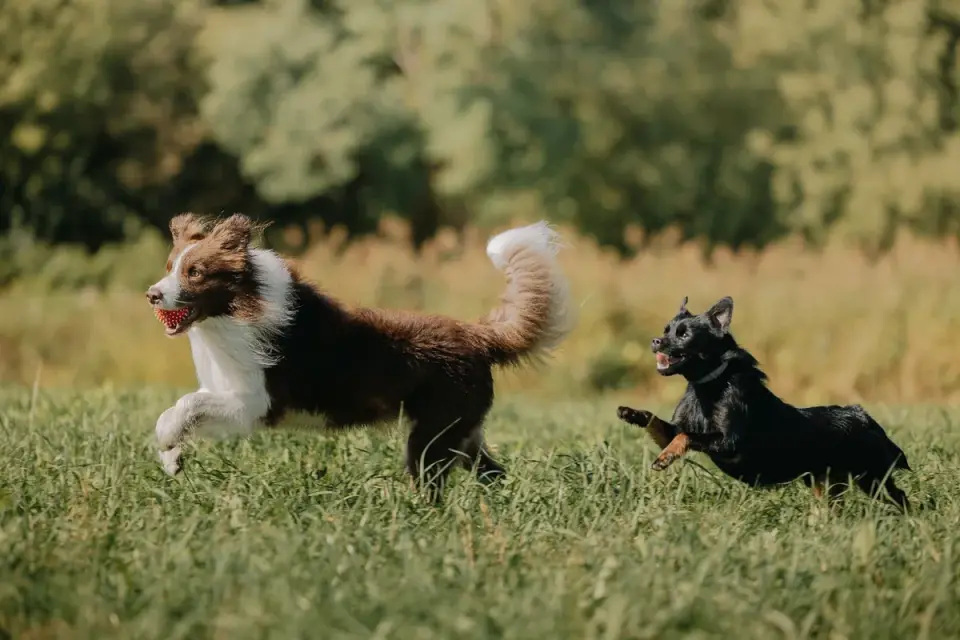
You can often tell dogs are playing rather than fighting by watching for role reversal — the chaser becoming the chased, again and again.
On this page
The first time I watched a Boxer and a Cattle Dog mix meet at a fence line, the Boxer dropped into a play bow, sprang sideways, and let out a bark that made both owners flinch. Nobody moved to intervene, and nobody needed to. Thirty seconds later the dogs were taking turns being chased across the yard. That bark sounded like trouble. It wasn’t.
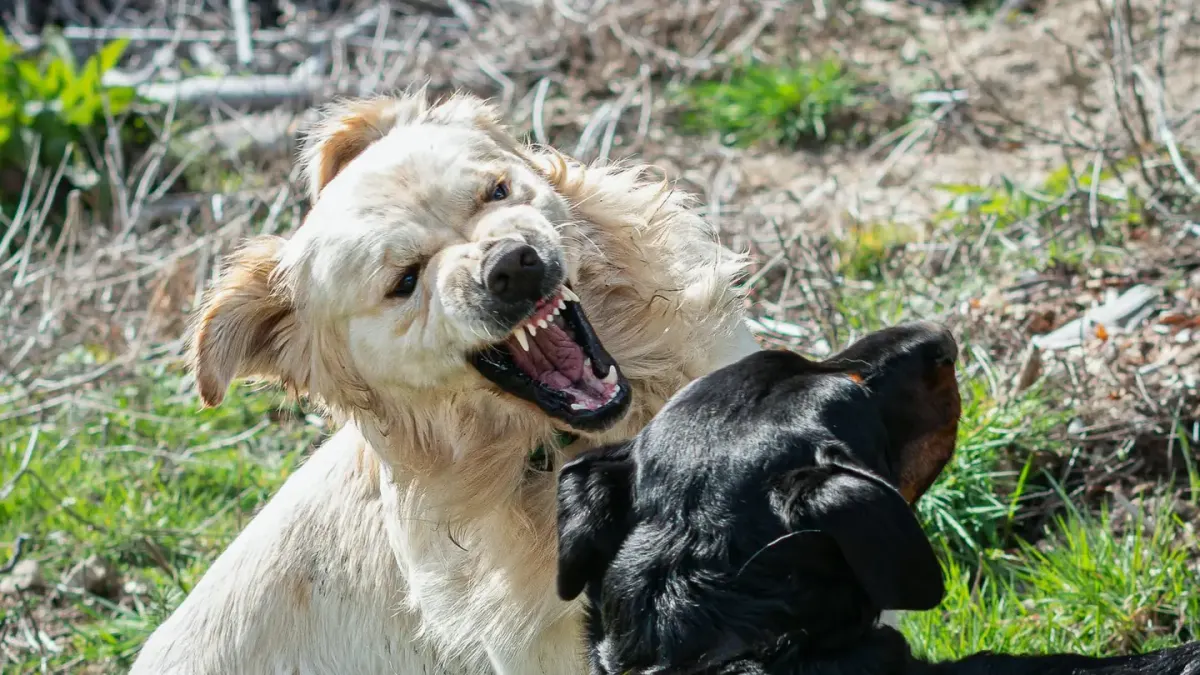
Owners ask me some version of the same question almost every week: how do you actually tell if dogs are playing or fighting? The honest answer is that noise is the least reliable part of the picture. Growls, barks, and even the occasional yelp show up in healthy play all the time. What tells you more is the shape of the interaction — who’s controlling it, whether it keeps changing, and what happens the instant one dog steps back.
The first few seconds tell you more than the next few minutes
Two dogs meeting for the first time almost always do a version of the same choreography: a wide arc approach, a sniff, a pause, maybe a play bow. That opening exchange sets the tone. A dog who bows, bounces on stiff front legs, or does a “play sneeze” is telling the other dog, and you, that whatever comes next is a game. A dog whose body goes still, whose weight shifts forward onto stiff legs, and whose tail goes up and rigid rather than loose is telling you something different before a single sound is made.
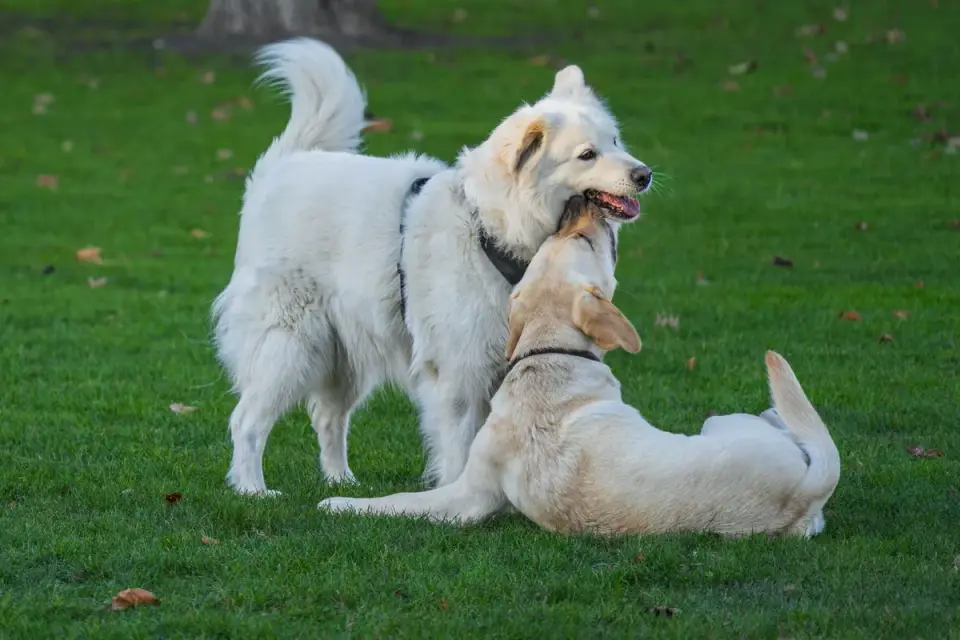
Loose is the word to hold onto. Play involves loose, bouncy, exaggerated movement — big sideways hops, open-mouthed “play faces,” ears that stay soft. Real conflict involves a tightening: a stiffer spine, a fixed stare, a tail that stops moving. If you watch enough dogs greet each other, that shift from loose to stiff becomes easier to spot than any single behavior on its own.
Role reversal is the single best tell
If I had to give an owner one rule to carry into a dog park, it would be this: watch for role reversal. In genuine play, the dog being chased will, within a minute or two, become the one doing the chasing. The dog pinned to the ground will roll back up and pin the other one. Bite pressure stays soft enough that the other dog barely reacts, and both dogs keep coming back for more.
A real fight doesn’t rotate like that. One dog is consistently on the offensive, the other is consistently trying to create distance, and there’s no self-handicapping — no exaggerated slow-motion pouncing, no obvious pulled bites. If you watch a pair of dogs for ninety seconds and the same dog is winning every exchange, that’s not a game with rules anymore.
I had a client, a couple with a young Vizsla named Otis and an older Shepherd mix, Daisy, who’d shared a house for about eight months without much drama. Around Otis’s second birthday, their play sessions started looking different — Daisy stopped initiating, started body-slamming rather than bowing, and one Tuesday evening Otis yelped and ran to the kitchen and stayed under the table for twenty minutes. Nothing about the incident looked dramatic from across the room. What mattered was the pattern underneath it: Daisy had quietly stopped rotating out of the dominant role weeks before that evening, and the owners hadn’t clocked it because the volume of noise hadn’t changed. Once I walked them through what to watch for instead of what to listen for, they caught the next shift in posture almost immediately and gave the dogs a supervised cool-down before it escalated again.
The signals that get missed until it’s too late
A few markers matter more than people expect:
- A “freeze” before contact. Any dog going still, especially with a hard stare, right before body contact is a warning sign, not a pause for effect.
- One dog repeatedly trying to leave. If a dog keeps turning away, moving behind furniture, or trying to end the interaction and the other keeps following, that’s not mutual play anymore.
- Pinning that doesn’t release. A quick pin-and-release is common in play. A pin that’s held down while the pinned dog struggles and can’t get up is not.
- Ears pinned flat and lips pulled back tight, as opposed to the loose, relaxed “play face” with an open mouth.
None of these signs work in isolation — context matters, and two dogs who know each other well can play rougher than two strangers ever should. That’s part of why this is genuinely hard to teach from a checklist. It gets easier with repetition, and it gets much easier once you know the two or three things worth watching instead of trying to track everything at once.
This overlaps with something I cover with clients whose dogs growl when petted — a growl or a stiff posture in one context isn’t automatically the same thing in another, and reading the surrounding body language always matters more than reading the sound alone. It’s also worth remembering that a dog who reacts big to sudden noise, the kind of dog who panics at a garbage truck, may simply have a lower threshold for arousal generally, which can make an ordinary rough-and-tumble play session look scarier from the sidelines than it actually is.
When things actually do tip over
Sometimes they do. A scuffle happens, there’s a yelp, and both dogs separate looking rattled rather than ready to keep playing. If that happens, the priority is a calm, unhurried separation — not scolding, not a big reaction from you, just space and a few minutes to settle. Dogs read our arousal too, and a panicked owner can turn a minor scuffle into a bigger deal for both animals.
For dogs who run a little hot generally — the ones who struggle to settle after any excitement, play included — some owners look at calming ingredients as one small piece of a broader plan alongside training and management. A systematic review in Cureus concluded that ashwagandha “has a moderate positive impact on stress reduction and cognitive performance” across the RCTs it analyzed, though that evidence base is built on human trials rather than dogs. L-theanine has similarly been studied in people; a review in Molecular Psychiatry noted a benefit “except for one study on psychotic anxiety (SMD = 0.54; 400 mg/day for 8 weeks).” Chamomile has a longer history of traditional use for relaxation, but a review in Biomedicines is candid that “for the remaining species, evidence is derived mainly from preclinical studies or traditional use” — worth knowing before anyone assumes a supplement will do the training’s job for it.
None of that replaces reading the dogs in front of you, and none of it replaces a trainer’s help if two dogs in the same household are having repeated, worsening conflicts. That’s a management and behavior-modification problem first.
I think about the couple with Otis and Daisy fairly often, because the fix wasn’t dramatic. It was a schedule of separate feeding, supervised short sessions instead of all-day free access, and a house rule that either dog could opt out of play without the other one following. Six weeks later, the body slams had stopped and Daisy was rotating back into the chased role again on her own. What changed wasn’t the dogs’ relationship overnight — it was that the owners finally knew what to watch for, and they intervened three seconds earlier than they used to. Three seconds, it turns out, is usually the entire difference between a scuffle and a session that ends with both dogs asking for more.
If you’re introducing a new dog to a household — including a recently adopted rescue still settling in — expect play styles to look different in week one than they will in month three, and give any early scuffle less weight than you might a similar one between two dogs who’ve known each other for years.
What I actually tell owners
Watch the pauses, watch who’s rotating between roles, and watch what happens the instant one dog tries to leave. If the play resumes on its own after a brief freeze, if both dogs keep initiating, and if nobody’s actually trying to get away, you’re probably watching a good, healthy game — even if it’s loud. If one dog is consistently overmatched, consistently trying to create distance, or genuinely can’t get away, it’s time to step in regardless of how the noise level sounds from where you’re standing.
So — the next time two dogs meet at the park and your stomach drops at the sound of it, what’s actually happening in the thirty seconds after the noise stops?
Sources
- Chamomile use across species in anxiety and stress research — Biomedicines
- Systematic review of ashwagandha and stress reduction — Cureus
- L-theanine and anxiety outcomes across trials — Molecular Psychiatry