Surviving Puppy Crate Crying at Night
Medically reviewed by Jessica Ennis, DVM, CVA — For general education — not a substitute for veterinary care.
Puppy crate crying almost always signals an unmet need, not stubbornness — here's the four-step plan that actually changes it.

On this page
- Distress crying and protest crying sound different once you’re listening for it
- Rule out the physical stuff before you rule in behavior
- Build tolerance the way you’d build any skill — in small, boring reps
- Where calming ingredients genuinely fit, and where they don’t
- My bottom line, after a lot of 2 a.m. phone calls
Marcus was eight weeks old, a Cavalier mix who weighed just under four pounds, when his owners called me on a Tuesday morning sounding like they hadn’t slept in days. They hadn’t. The crate sat at the foot of their bed, and every night around 1 a.m. Marcus started up — not a whimper, a full, rhythmic wail that didn’t stop for twenty minutes no matter what they tried. They’d already caved twice and let him sleep on the comforter, which worked instantly and worried them even more. Was he in pain? Was the crate cruel? Were they creating a habit they’d regret in six months? None of those questions had a one-line answer, and that’s the honest truth I gave them before we built anything resembling a plan.
Crying in the crate at night is one of the most common calls I get from new puppy owners, and it’s rarely one thing. It can be a puppy whose bladder genuinely can’t make it eight hours yet. It can be a puppy who was napping all day and is now wide awake at 2 a.m. It can be straightforward separation distress, especially in the first week away from littermates. And sometimes, less often than owners fear, it’s a puppy who’s cold, too warm, or lying on a joint that’s uncomfortable. Sorting out which one you’re dealing with is the actual work — the crying itself is just the signal.
Distress crying and protest crying sound different once you’re listening for it
This is the first decision point, and it matters because the two responses are almost opposite. Distress crying tends to be steady, high-pitched, and doesn’t taper — it often comes with pacing, scratching at the crate door, drooling, or shaking. It’s the nervous system saying something is genuinely wrong. Protest crying, by contrast, usually has pauses. It escalates when you appear or speak, and it often stops within a few minutes of being consistently ignored, then restarts if you come back. A puppy who cries the second you leave the room and stops the second you return is testing a hypothesis, not suffering.
I tell owners to time it, honestly, with a phone on the nightstand. Ten straight minutes of unbroken crying with physical signs of distress is a different problem than intermittent fussing that dies down once the puppy realizes nothing is happening. The first deserves a response. The second deserves patience and a very short mental script you repeat to yourself at 2 a.m.: this is developmentally normal, and reacting teaches the wrong lesson.
Rule out the physical stuff before you rule in behavior
Before any training plan, I ask three questions on that first call: how old is the puppy, when did they last eat or drink, and when did they last go outside. A ten-week-old puppy’s bladder often can’t hold through a full eight-hour night yet, and crying twenty minutes after a midnight bathroom break versus five hours in tells you very different things. I also ask about the crate itself — size, surface, and placement. A crate that’s too large lets a puppy soil one end and sleep in the other, which undermines housetraining and adds a wet, uncomfortable variable to the mix. If you haven’t settled on a crate size and setup yet, our guide to setting up a crate for a puppy’s first night walks through sizing, bedding, and placement in more detail than I can cover here.
Temperature, teething discomfort, and a too-firm crate pad are the physical culprits I see most. None of them require a trainer. They require noticing.
Build tolerance the way you’d build any skill — in small, boring reps
Once the physical variables are controlled for, the actual fix is unglamorous: gradual desensitization to being alone in the crate, done in daylight hours when nobody’s exhausted. Short crate stretches while you’re home and visible. Then short stretches while you leave the room. Then longer ones. The mistake I see constantly is owners who only use the crate at bedtime, so the puppy’s very first experience of “alone in a box” happens at the hardest possible hour, with the fewest resources for coping. A puppy who’s practiced ten-minute solo stretches after breakfast handles an 11 p.m. crate far better than one encountering it cold.
This is also where a consistent wind-down routine earns its keep — the same short walk, same water cutoff time, same low light and quiet thirty minutes before bed, every night. If your dog also seems to struggle winding down generally, not just in the crate, it’s worth reading about why some dogs won’t settle in the evening, since overtiredness and understimulation both mimic crate distress and respond to the same fix: a predictable pre-bed routine.
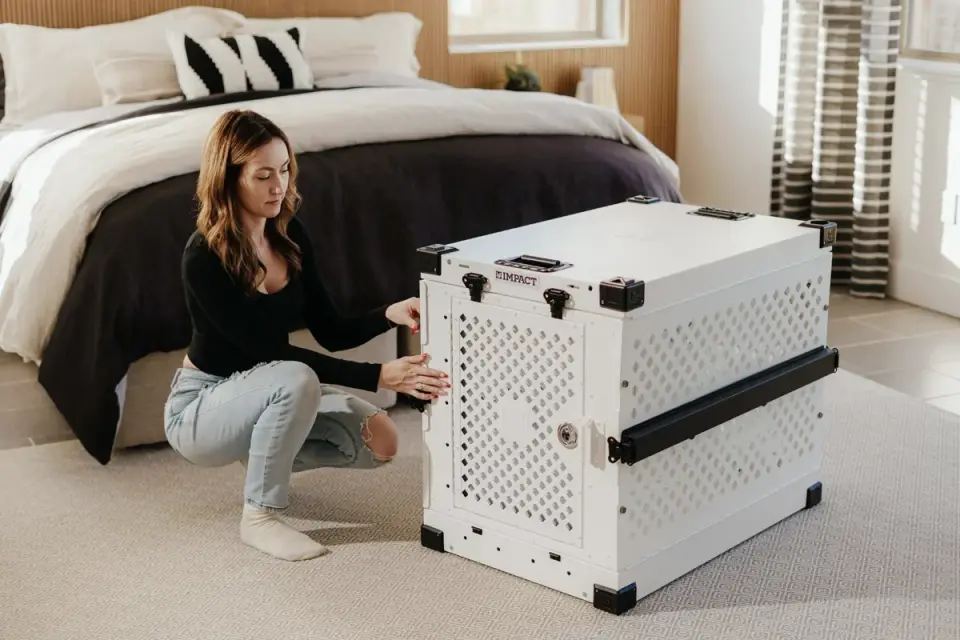
I had a client, a nurse who worked overnight shifts three days a week, whose eleven-week-old Lab mix, Piper, screamed every single time the crate door clicked shut — whether it was 7 p.m. or 7 a.m. We stripped the schedule back to five-minute reps, door open, treat scattered inside, no closing the latch at all for the first four days. By day six we were closing the door for sixty seconds while she stood two feet away. It took eleven days before Piper tolerated a closed door for a full hour with her owner out of sight, and another two weeks before overnight stretches got quiet. That’s a longer timeline than most owners expect walking in, and I tell them that up front now, because the ones who brace for two to three weeks stick with the plan; the ones expecting three nights give up on day four and go back to the couch.
Where calming ingredients genuinely fit, and where they don’t
Supplements are not a substitute for the tolerance-building work above, but for a puppy whose nervous system is running hot during the adjustment period, a few ingredients have real evidence behind their structure/function role in stress support — with real caveats about species and dose.
Chamomile is the most studied of the traditional calming botanicals, though a review in Biomedicines notes that outside a handful of well-studied species, “evidence is derived mainly from preclinical studies or traditional use” — meaning the case for dogs specifically leans more on history of use than on canine clinical trials. KSM-66 ashwagandha has firmer human data: a systematic review in Cureus found that across multiple randomized controlled trials, ashwagandha showed “a moderate positive impact on stress reduction and cognitive performance.” L-theanine, an amino acid naturally found in tea, has similar human-trial support — a review in Molecular Psychiatry cites a study finding benefit “except for one study on psychotic anxiety (SMD = 0.54; 400 mg/day for 8 weeks),” a dose and duration studied in adult humans, not puppies.
I say this to owners plainly: these ingredients may help support a stressed nervous system during a hard adjustment window, but none of them override poor crate setup, an oversized crate, or a puppy who’s simply too young to hold their bladder all night. Ask your veterinarian before adding anything, particularly for a puppy under four months old, since dosing data in that age group is thin across the board.
Never use a crate as a place your puppy associates with being sent away in anger — closing the door on a scared or crying puppy as punishment will make every step above harder, not easier. If your puppy also shadows you obsessively during the day and seems to fall apart the instant you’re out of sight, that’s a related but distinct pattern worth reading up on separately; our guide on independence training for a velcro dog covers the daytime half of the same underlying issue.
My bottom line, after a lot of 2 a.m. phone calls
Most puppy crate crying is a normal, temporary developmental stage that resolves in one to three weeks with consistent daytime practice, a properly sized crate, and a boring, predictable bedtime routine — not with rushing in at the first sound or abandoning the crate altogether. If crying is constant, doesn’t taper with time or age, or comes with signs like drooling, panting, self-injury, or refusal to eat, that’s no longer a normal-adjustment pattern, and it’s time to loop in your veterinarian or a certified trainer rather than waiting it out.
Frequently asked questions
How long is it normal for a puppy to cry in the crate at night?
Some crying in the first several nights is normal and typically eases within one to three weeks as the puppy adjusts, especially with consistent daytime crate practice. Crying that isn't improving after three weeks, or that's constant and severe, is worth discussing with your veterinarian.
Should I ever let my puppy cry it out in the crate?
Not blindly. Check for physical needs first — a full bladder, teething discomfort, temperature, or an oversized crate — before assuming it's protest crying. Once physical causes are ruled out, brief, tapering protest crying can be ridden out; prolonged, unbroken distress crying usually shouldn't be.
Will a calming supplement stop crate crying on its own?
No. Ingredients like chamomile, KSM-66 ashwagandha, and L-theanine have evidence supporting a general stress-support role, but they work alongside gradual crate training and a proper setup, not as a replacement for it. Talk to your veterinarian before giving anything to a puppy under four months old.