Toe Grips vs Paw Wax vs Nail Grinding for Traction on Slippery Floors
Toe grips solve traction on smooth floors fastest, but nail grinding fixes the mechanics that cause slipping in the first place.
On this page
A Labrador mix named Otis, twelve years old and about seventy pounds, used to belly-flop trying to get from the kitchen tile to the living room rug. His owner first noticed it on a Tuesday morning — Otis’s back legs shot out sideways at the exact spot where the flooring changed, and he went down hard enough that she started laying bath mats end to end just to get him from his bed to his food bowl. That’s the appointment where I usually start asking three questions before we talk about products: how long are the nails, what does the pad look like, and is this new or has it been building for months. The answer determines whether we’re solving a traction problem or a mechanics problem, and those are not the same fix.
What’s actually happening when a dog slides
A dog’s paw pad is built for grip on dirt, grass, and uneven ground — not for a flat, low-friction surface like sealed hardwood or polished tile. When a nail is long enough to strike the floor before the pad does, the dog’s foot loses its normal contact angle, and the leg can skate out from under the hip on a turn. This is why sliding tends to show up first in older dogs, dogs recovering from orthopedic surgery, and dogs with arthritis: any of those can also weaken the hind end enough that the dog can’t correct a slip the way a younger, stronger dog would.
It’s worth being honest about what the research actually shows here, because the assumption that “long nails cause bad gait” is intuitive but not fully proven. A 2026 study in Frontiers in Veterinary Science used pressure-sensing treadmill analysis on healthy dogs before and after a nail trim and found no significant change in stride length, stance phase duration, or vertical ground reaction force. The one measurable difference was in the front paws, where contact length was about 2mm shorter after trimming, and center-of-pressure shift was slightly reduced. The authors’ read is that long nails may be more a symptom of an already-abnormal gait — a dog that isn’t wearing its nails down naturally through normal movement — than the direct cause of instability. That doesn’t mean nail length is irrelevant to traction; it means the causal arrow may run partly in the other direction, and I try not to oversell nail trims as a standalone fix for a dog that’s genuinely sliding.
Toe grips: fast traction, no training curve
Toe grips are small rubber sleeves that fit over the nail tip rather than the paw pad. According to toegrips.com: Dr. Buzby’s ToeGrips, the grips sit on the poorly innervated nail tip rather than covering the pad or skin, which is why most dogs tolerate them without the foot-shaking reaction you often see with boots. They typically last one to three months depending on the dog’s size and gait, and they wear faster on dogs with an already-abnormal stride. The appeal is speed: you fit them and the dog has grip within the same walk, with essentially no acclimation period. The tradeoff is upkeep — they need periodic replacement, sizing has to be right, and they don’t do anything for a dog whose real problem is muscle weakness rather than a slick nail tip.
Paw wax: pad-level grip with a maintenance cost
Paw wax works from the opposite end of the foot. These are blends of harder waxes — commonly white and yellow beeswax, carnauba, and candelilla — combined with softer oils, and they’re applied directly to the paw pad. After the softer oils absorb, the harder wax residue is what remains on the pad surface to add friction on smooth flooring, similar to how the same waxes are marketed to protect pads from ice, salt, and hot pavement. In my experience this is the option owners reach for when a dog also has dry, cracking pads in winter, since it does double duty. It’s also the shortest-acting of the three: wax wears off with normal walking and needs to be reapplied every few days to weekly, and it can track onto floors or furniture if it’s overapplied. I don’t rely on it as a primary traction fix for a dog with a real mobility problem, but as a pad-conditioning add-on it’s reasonable.
Nail grinding: addressing the mechanics, not just the surface
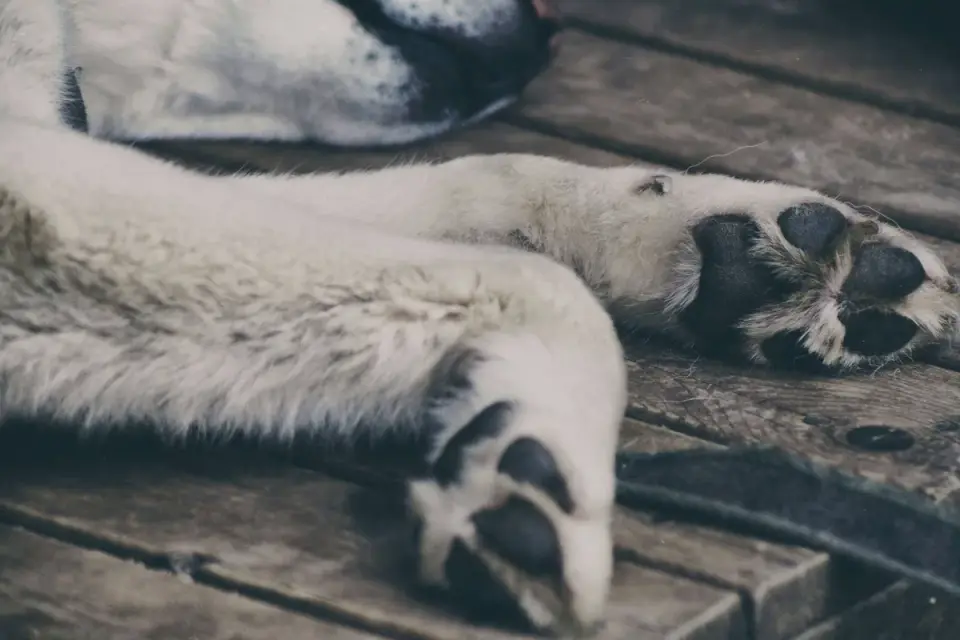
Nail grinding — using a rotary tool to gradually shorten and round the nail rather than clipping it in one cut — is less a “traction product” and more a maintenance habit that keeps the nail from contacting the floor at an angle that destabilizes the foot. Given the Frontiers findings above, I’m careful not to promise a dog will stop sliding because of a grind alone. What I do tell owners is that keeping nails consistently short removes one variable, it’s the only one of the three options with no ongoing cost once you own the tool, and it pairs well with the other two rather than competing with them. A dog with genuinely long nails and a weak hind end usually needs the grind plus toe grips, not one or the other.
I had a fourteen-year-old dachshund in my practice, arthritic through the spine, whose owner had been managing slipping with bath towels taped to the kitchen floor for nearly a year before we talked through actual options. We started with a nail grind because her nails were well past the pad line, added toe grips for the kitchen and hallway specifically, and left the towels down over the two open stretches of hardwood she still had to cross. Within about three weeks the owner told me she’d stopped hearing the dog’s nails “click-scrabbling” on the tile — a small thing, but it was the marker she’d been watching for. That’s one dog, not a study result, and I mention it only because it’s the pattern I see most often: layering, not picking a single winner.
If a dog is also struggling on stairs specifically rather than open floor, that’s often a different fix — see our guide to non-slip stair treads for a dog that struggles with steps for that narrower problem.
Which one, and for which dog
If a household needs traction today, toe grips solve that fastest and with the least mess. If a dog also has dry or cracking pads, paw wax is a reasonable add-on but not a standalone fix for a mobility problem. If sliding has been building for months rather than appearing overnight, start with a nail grind and a vet visit to rule out an underlying orthopedic or neurologic cause — sudden, severe, or one-sided slipping is not a flooring problem and deserves an exam before any product gets purchased. For senior dogs specifically, I lean toward grinding plus toe grips together, because the Frontiers data leaves me unwilling to promise nail care alone will fix a hind-end weakness problem.
A few adjacent setup issues are worth checking at the same time: a crate placed on bare hardwood can be its own slipping spot for a new puppy still building coordination (see our crate setup guide for a puppy’s first night), and a feeding station on tile can turn into its own slick patch if bowls slide during meals — our piece on mats and trays for a messy eater’s feeding station covers that separately.
So which of these actually gets your dog through the kitchen without going down? Probably not just one of them — it’s worth asking your vet which combination fits the dog you actually have, not the dog on the packaging.
Frequently asked questions
Do toe grips hurt or bother most dogs?
Most tolerate them well because they sit on the nail tip, which has little sensation, rather than covering the paw pad itself.
Can I use paw wax and toe grips together?
Yes — wax addresses pad dryness and light grip, while toe grips address nail-tip contact with the floor; they don't conflict.
Should I trim my dog's nails if they're slipping?
Keep nails short regardless, but don't expect trimming alone to resolve significant sliding, especially in a senior or arthritic dog — recent gait research found trimming didn't measurably change stride or force in healthy dogs.
Sources
- Trimming of nails in healthy dogs does not change gait parameters when comparing pre- and post-nail trim — Frontiers in Veterinary Science
- Dr. Buzby's ToeGrips for Dogs | Stop Your Dog from Slipping — toegrips.com