Soft Calming Treats vs. Calming Sprays: Which One Actually Settles a Dog Down?
Medically reviewed by Justin Shmalberg, DVM, CVA, ACVN, ACVSMR — For general education — not a substitute for veterinary care.
If I had to bet on one tool calming a genuinely anxious dog by dinnertime, I'd reach for the chew before the spray — but I'd want the spray in the room too.
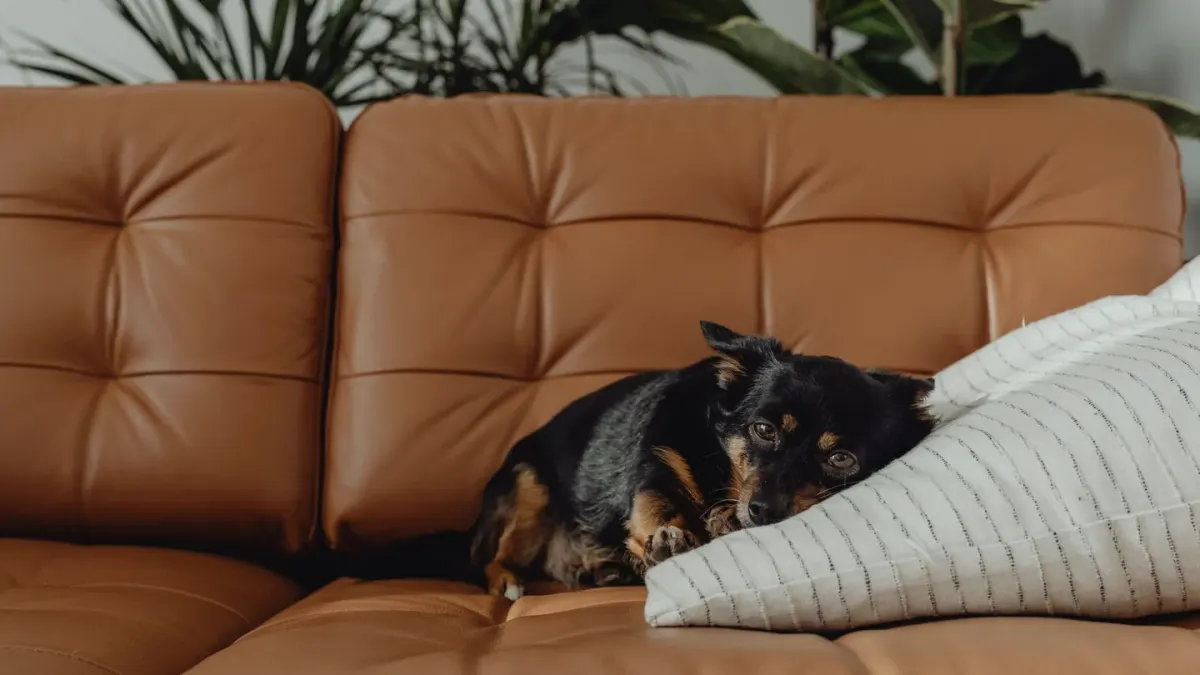
Start with the direct answer: for a dog with a specific, situational trigger — thunderstorms, fireworks, a vet visit — a soft calming treat built around a dosed, studied ingredient like L-theanine tends to produce more consistent, measurable change than a pheromone spray. The spray isn’t useless. It’s just solving a narrower problem, and it’s easy to misuse.
I want to be honest about why I land there, because the research on both categories is thinner than the marketing suggests.
Soft chews put a measured dose of an active ingredient into the dog’s system. L-theanine, an amino acid derived from tea plants, is the best-studied calming ingredient on the market. It’s thought to work by modulating GABA, serotonin, and dopamine while damping glutamate, the brain’s main excitatory signal. A small open-label study of storm-sensitive, client-owned dogs given L-theanine (marketed as Anxitane) before storm exposure found meaningful owner-reported reductions in drooling, following, panting, pacing, and hiding, according to the study published in the Journal of Veterinary Behavior. That’s a real signal, even though the sample was small and open-label — nobody was blinded, so owner expectation could be inflating the numbers. I weigh that limitation seriously and still find it more convincing than most calming-product literature I read.
A separate small trial testing treats containing CBD, L-tryptophan, and alpha-casozepine together found a mild stress-reducing effect in dogs, reported in a study on PMC — mild being the operative word. These aren’t sedatives. They’re structure/function ingredients meant to take the edge off, not switch a dog’s nervous system off like a benzodiazepine would.
Pheromone sprays work on a completely different mechanism, and the evidence for them is genuinely mixed — not just cautious-sounding, actually mixed. Dog-appeasing pheromone (DAP), sold as Adaptil, is a synthetic analog of the fatty-acid pheromone a nursing mother releases to reassure puppies. A systematic review in Veterinary Evidence found moderate evidence DAP can reduce some fear behaviors tied to thunderstorm noise, and weak evidence it helps with non-specific stress in hospitalized dogs — but concluded there’s a continued knowledge gap around whether it does anything for everyday, generalized anxiety. The same review found no evidence that spray beats diffuser or collar as a delivery format, which matters if you’re deciding what to buy. A shelter-based study on DAP spray specifically found it reduced mean bark intensity by about 6.5 decibels but didn’t significantly change how often dogs barked or showed stress behavior overall, per findings published on ScienceDirect.
In my practice, the dog I think about most is a nine-year-old rescue beagle named Gus, thirty-one pounds, whose owner brought him in the week before July Fourth. He’d start pacing the kitchen linoleum by early afternoon on days with any thunder in the forecast, then dig at the baseboard behind the couch by evening. She’d tried a plug-in diffuser first, mostly because it was cheap and she could set it and forget it. It took the edge off the pacing but did nothing for the digging. We layered in an L-theanine soft chew dosed about ninety minutes before predicted storm onset, and by the second storm of that summer, the digging had mostly stopped — he’d still pace some, but he’d settle on his bed instead of working at the baseboard. That’s one dog’s timeline, not a trial result, but it’s the pattern I see often enough to trust the layering approach over picking just one tool.
Here’s the counterargument I take seriously: pheromone sprays have essentially no systemic side-effect profile, no interaction risk with other medications, and no dosing math to get wrong — you spray a room or a crate liner and walk away. For a dog on multiple medications, or an owner who’s nervous about giving one more oral product, that safety margin is real and worth something. I don’t dismiss it.
Where I still land is that a soft chew is doing more measurable physiological work, provided you actually read the label. Look for the milligram dose of the active ingredient per chew, not just its presence on the ingredient list — a chew with 50mg of L-theanine and one with 5mg are not interchangeable products, even if both say “calming” on the front. Products carrying the NASC: National Animal Supplement Council Quality Seal have passed a third-party facility audit and committed to adverse-event reporting, which is a reasonable proxy for a manufacturer that isn’t cutting corners — it’s not proof the formula works, but it’s proof the company is accountable if something goes wrong.
If your dog’s anxiety is more constant than situational — general house-alone stress, new-environment jitters, low-grade reactivity — the format question matters less than a related one: is a chew even the right delivery mechanism, or would a powder or liquid dose better for a dog who’s picky about treats? That’s covered in more depth in Chew vs. Powder vs. Liquid Supplements for Dogs, and it’s worth reading before you commit to a chew-only plan.
One more short point, because it gets lost in the marketing: neither product replaces desensitization work for a dog with a real phobia.
A calming aid buys you a calmer window to work in — it doesn’t do the behavioral training for you. For dogs whose anxiety shows up specifically around car travel, the same logic of matching the tool to the trigger applies; see Ginger Versus Chamomile for Dog Car Sickness for a parallel case. And if the anxiety is muscling into full-blown panic — shaking, hiding for hours, self-injury attempts at doors or windows — a chew or a spray is undersized for the job, and that’s a conversation for your vet about behavioral medication, not a supplement aisle decision.
I’ve also had owners ask me whether a compression garment does more than either of these — it’s a fair question, and the honest answer is that it’s solving yet a third mechanism again; I laid out that comparison in Thundershirt vs. an Oral Calming Aid for Dog Anxiety.
Near the end of a long case like Gus’s, I always come back to the same instinct: don’t ask a spray to do a chew’s job, and don’t ask a chew to do a trainer’s job. The owners I see who get the best results are the ones running both a dosed chew before the known trigger and a pheromone diffuser as ambient background support, rather than betting the whole outcome on one product.
Next step: if your dog has a specific, predictable trigger, start with a soft chew dosed for that ingredient at least an hour before the event, confirm the milligram dose on the label, and layer a pheromone diffuser in the room your dog retreats to. Track what actually changes — pacing, hiding, vocalizing — over two or three exposures before deciding it isn’t working.
Frequently asked questions
Can I use a calming chew and a pheromone spray at the same time?
Yes. They work through different mechanisms — an oral ingredient like L-theanine acts on neurotransmitters, while pheromone sprays act on scent-based reassurance signaling — so layering them is reasonable rather than redundant.
How long before a known trigger should I give a calming chew?
Most L-theanine products are dosed to be given roughly 60–90 minutes before the anticipated stressful event, since the ingredient needs time to take effect; check the specific product label for its studied timing.
Do pheromone sprays work for general, everyday anxiety?
The evidence is weaker here. Reviews have found only moderate support for storm-specific fear and weak support for hospitalization stress, with a real knowledge gap around non-specific, everyday anxiety.
Sources
- An open-label prospective study of the use of l-theanine (Anxitane) in storm-sensitive client-owned dogs — Journal of Veterinary Behavior (ScienceDirect)
- Treats containing cannabidiol, L-tryptophan and α-casozepine have a mild stress-reducing effect in dogs — PMC
- Can dog appeasing pheromone ameliorate stress behaviours associated with anxiety in mature domestic dogs? — Veterinary Evidence
- The effects of dog-appeasing pheromone spray upon canine vocalizations and stress-related behaviors in a rescue shelter — ScienceDirect
- National Animal Supplement Council — NASC