Signs of Liver Problems in Senior Dogs
A vet-trained eye on the early, easy-to-miss signs of liver trouble in older dogs — what the bloodwork actually catches, and when a symptom stops being "just aging."
Liver disease in older dogs rarely announces itself; it shows up first as a slightly duller appetite, then as bloodwork you almost didn't order.
On this page
Before you read another paragraph, here’s the checklist I actually use when an owner tells me their senior dog “just isn’t right”:
- Appetite dip that lasts more than a few days — not a skipped meal, a pattern
- Increased thirst and urination that wasn’t there six months ago
- Vomiting or soft stool that recurs rather than a one-off stomach upset
- Yellow tint to the gums, the whites of the eyes, or the inner ear skin (jaundice)
- A pot-bellied look or visible fluid in the abdomen (ascites)
- Behavior changes — disorientation, circling, pressing the head against furniture, sudden wobbliness
- Bloodwork flags — elevated ALT, ALP, or bile acids on a routine senior panel, even with no outward symptoms
That last line item matters most, and I’ll get to why. But first, the dog.
A 9-year-old dachshund, 19 pounds, came in because her owner thought she was “just slowing down.” No vomiting, no jaundice, appetite fine. The only abnormal finding was a mildly elevated ALP on a routine senior panel — the kind of number that’s easy to wave off as “probably steroid-induced, recheck in six months.” We didn’t wave it off. A paired bile acids test, drawn fasting and two hours post-prandial, came back elevated enough to justify an abdominal ultrasound. That’s the pattern worth internalizing: by the time a senior dog looks sick from liver disease, the disease has usually had a head start.
Why the early signs get missed
Here’s the uncomfortable structural problem with liver disease in older dogs: the liver has enormous functional reserve. A dog can lose a large share of working liver tissue and still run essentially normal enzyme values, which is exactly why VCA Animal Hospitals notes that early disease may produce minimal or no signs at all, surfacing only on routine wellness screening. Vomiting, a soft stool, a slightly lower appetite, drinking a little more water — these are the kind of vague, low-grade signs owners (understandably) attribute to normal aging. They’re also, per the same source, the earliest signs actually described in the veterinary literature.
I’d rather over-test a healthy-looking senior than under-test a sick one. That’s a defensible clinical position, not a reflexive one — over-testing has real costs too, in owner anxiety and unnecessary follow-up. But liver disease is one of the categories where silent progression is well documented, and a fasting-plus-postprandial bile acids panel is neither expensive nor invasive relative to what’s missed by skipping it.
What jaundice and a swollen belly are actually telling you
Once a senior dog shows visible signs, the physiology behind them is fairly specific, and it’s worth knowing so you’re not guessing at the exam table. Jaundice happens when bile pigment builds up in blood and tissue because the liver has lost the ability to process it properly, turning the gums, eye whites, and skin a yellowish or orange tinge, according to Merck Veterinary Manual. A pot-bellied appearance — ascites — has a different mechanism: it shows up when the liver stops making enough albumin to hold fluid inside blood vessels, so fluid leaks into the abdomen instead. Neither sign is subtle once it’s present. Both mean the disease is no longer early.
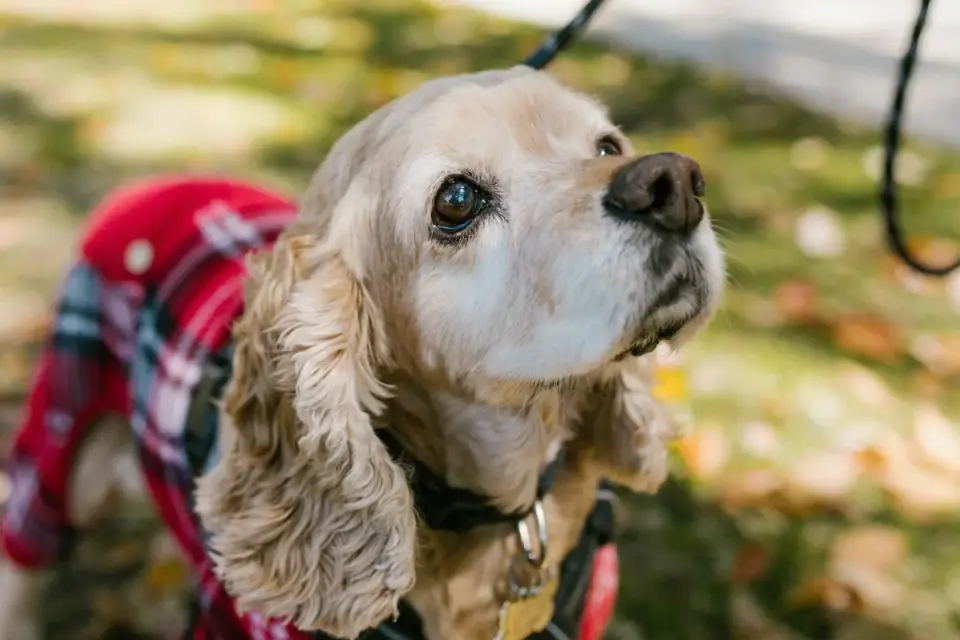
There’s a middle scenario I think about more than either of those, though, because it’s the one that actually changes management. A 12-year-old cocker spaniel, 27 pounds, was brought in at week three of “acting a little off” — not vomiting, not jaundiced, just intermittently dull and, per the owner, “staring at the wall sometimes.” Hepatic encephalopathy from advanced liver disease can look exactly like that: dullness, an unsteady gait, head pressing, occasionally seizures, caused by gut-derived toxins bypassing a liver that can no longer filter them, as VCA Animal Hospitals describes. In this dog it wasn’t that — an ear infection turned out to be the culprit — but the workup that ruled liver disease out (ammonia level, bile acids, a basic metabolic panel) is the same workup I’d run if it had been. The edge case here isn’t the diagnosis; it’s that vague neurologic-seeming signs in an older dog deserve a liver panel before they get filed under “cognitive decline” or “just getting old.”
Reading the bloodwork without overreading it
ALT and AST tell you about liver cell damage; ALP and GGT tend to track with bile flow obstruction rather than direct cell injury — and any of those four can be elevated for reasons that have nothing to do with the liver at all, which is the part owners find frustrating and I find clinically useful. A single mildly elevated ALP on an otherwise unremarkable senior panel is not a diagnosis. It’s a prompt to recheck, correlate with clinical signs, and consider bile acids testing, because bile acids are a far more sensitive and specific marker of actual liver function than the enzymes alone.
This is also where I get careful about supplement claims, because the space is full of them. Ingredients like quercetin and resveratrol show up constantly in senior-dog longevity products marketed toward “liver support” or “cellular health,” and the evidence behind them is real but narrow. In at least one vet-reviewed formulation I’ve seen the label for, quercetin is dosed at 100 mg per two-chew serving and described as an antioxidant studied for immune and cellular support, alongside 40 mg of resveratrol per serving described the same way — as an antioxidant supporting cellular health and vitality, not as a liver treatment. Neither of those is a liver-disease claim, and neither should be read as one — they’re structure/function statements about general cellular antioxidant activity, and separate laboratory work on resveratrol in other species has actually shown that higher embryonic exposure can shorten lifespan rather than extend it (DOI.1016/j.phymed.2026.158531), which is a good reminder that “antioxidant” doesn’t automatically mean “more is better” or “treats this organ.” If a bag promises liver support from an antioxidant blend without naming a dose or a mechanism, that’s the label to be skeptical of, not the one to trust.
What actually changes the outcome
None of this replaces regular senior bloodwork, and I’d rather be blunt about that than gentle about it. Twice-yearly screening for a senior dog isn’t overcautious — it’s the mechanism by which “silent” liver disease gets caught while it’s still manageable rather than after jaundice or ascites shows up. If you want a fuller framework for what a senior wellness visit should actually include beyond the liver panel, The Best Daily Routine for a Healthy Senior Dog’s Vitality walks through it, and How Often Should Senior Dogs Get Bloodwork for Early Disease Detection? gets specific about intervals.
The practical next step, if you’ve read this far because something about your own dog nagged at you: don’t wait for the yellow gums. Book the senior panel, ask specifically whether bile acids testing makes sense given the numbers, and bring a plain list of what’s changed — appetite, water intake, stool, energy — because that list is usually more diagnostic than it feels like it should be. If your dog is already on a longevity supplement with quercetin, resveratrol, or an NAD+ precursor like nicotinamide riboside, that’s worth mentioning to your vet too, not because it’s dangerous, but because it can complicate interpretation of certain lab values, and a vet who knows the full picture makes a better call. For related questions about dosing format and daily supplement logistics, see Can You Crush a Longevity Chew and Sprinkle It on Senior Dog Food? and Cost Per Day of a Longevity Chew Regimen for a Senior Dog.
Frequently asked questions
Can a senior dog have liver disease with completely normal bloodwork?
Yes, in the earliest stages. The liver has substantial functional reserve, so standard enzyme panels can look normal even when disease has already started; this is part of why unexplained vague signs (appetite dip, increased thirst) in an older dog deserve a closer look rather than a wait-and-see approach.
Is jaundice always obvious?
It can be subtle at first — a faint yellow tinge to the gums or the whites of the eyes rather than a dramatic color change. Checking gum color under good light during routine at-home checks makes it easier to catch early.
Does an elevated ALP always mean liver disease in an older dog?
No. ALP can rise for several reasons unrelated to primary liver disease, including steroid exposure and bone conditions, which is why a single elevated value usually prompts a recheck or bile acids test rather than an immediate diagnosis.
Sources
- Chronic Hepatitis in Dogs — VCA Animal Hospitals
- Disorders of the Liver and Gallbladder in Dogs — Merck Veterinary Manual